Showing posts with label European Union. Show all posts

Tuesday, March 8, 2022

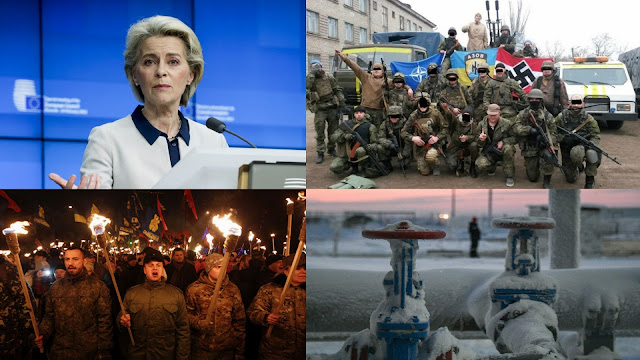
Ukraine - Europe, Energy Supplies & Economic Collapse


By: Stewart Brennan

(This essay was published and shared on Global Research)

As the price of oil, gasoline and natural gas skyrockets around the world, we have come to a major crossroads in history that has the potential to usher in a massive economic collapse of Europe, the United States, and the world.

The additional economic hardships that will befall our communities due to the rising costs of energy, will most likely be blamed on Russia by a cartel of western nations, just as they blamed the self-inflicted economic hardships the world suffered over the last two years, on an orchestrated pandemic [01]. 

However, the economic energy crisis did not happen all of a sudden, nor was it one event that triggered energy prices to reach the unimagined levels they have reached today, around the world.

Energy Costs March 8th, 2022

- $1.94.9 per liter of gasoline and climbing in Montreal
- $376.00 per mega watt hour for natural gas in Europe [02],
- $130.00 per barrel of oil [03]

The energy crisis was triggered long ago by a series of violent events created by the United States and its allies for control of the declining energy supplies and resources around the world. Two Decades of War crimes that continue on oil producing nations such as Iraq, Libya, Syria, and Yemen, plus their crippling economic sanctions on major independent oil producing nations such as Venezuela, Iran and Russia, have brought the world to the brink of economic collapse.

All of these criminal actions can only be seen as resource wars, due to declining energy supply under the western nations control.

Ukraine

The invasion of Ukraine by Russia is a climactic moment, which culminated through a series of violent events in Ukraine that began by a western backed color revolution which then led to a coup and overthrew of the elected Yanukovich government in 2014. (See Two documentaries here [04] and here [05])

The following 8 years saw American, British, Canadian and European governments arm, train and fund violent elements within the Ukraine Military which then unleashed their genocidal belligerence on the Russian speaking population in the Donbass region.

The western funded operation in Ukraine was very similar to the one they launched on the Syrian people in 2011, which ultimately provoked Russia to step in by 2015 and help their Syrian neighbor, Bashar al-Assad, as Syria was overrun by western backed genocidal terrorists. Russia’s involvement was based out of fear that the western backed terrorist invasion, would spill over into Russia.

The only difference between the western operations in Ukraine and Syria is that the 2014 western orchestrated coup in Ukraine was successful, whereas the attempted terrorist coup on the elected leader in Syria, Bashar al-Assad, was not successful due to Russia’s decision to take an active role in the security of the Syrian nation in 2015. However, the U.S military is illegally occupying the oil producing areas in eastern and northeastern Syria where they are involved in the daily theft of Syrian oil. The U.S. government has also caused great economic hardship on the Syrian people through crippling sanctions, and the destruction of their grain supplies.

In Ukraine, where many of the Russian gas pipelines run through to Europe, the west has done exactly what the Russians feared, as they’ve armed, trained and funded ultra nationalist thugs with a genocidal mindset, that are focused on the Russian speaking people of Ukraine and Russia itself. (See Here [06] and Here [07])

The Russian’s are not playing games, they are deadly serious about protecting themselves from sinister overt and covert western operations against it. The western cartel of nations led by the United States, Britain and the European Union are playing a very dangerous game as they continue their insane belligerent terrorist foreign policy of arming and funding a terrorist army against the Russian Military. NATO’s forces might not be on the ground in Ukraine, but the proxy army of thugs that they armed and trained, is directly engaged. 

Countries within this coalition of the insane, such as Australia, has even gone so far as to push for censorship and sanctions on anyone that brings truthful information favoring Russia’s side of the story [08]. In seems that the Australian government doesn’t believe that the ultra nationalists and Neo-Nazi’s in Ukraine exist and that 15,000 civilian deaths in the Donbass region are fake! 

The denial and false narrative that Australia stands on, will most likely be adopted by the cartel of NATO nations as well.

As I said in my last post,

“The American, Canadian and European leaders that support these fascists and Neo-Nazi’s in Ukraine, confirm what our western leaders are…I mean, who could support fascism but a fascist.”

In hindsight, the last two years of oppressive and dictatorial mandates by our western governments for a false pandemic, has shown us just how tyrannical and oppressive our western governments have become (See Here [09] and Here [10]).

Of special note here is that even as energy demand was drastically reduced over the last two years, gasoline prices continued to rise. Now however, we are at the cusp of economic collapse as the so-called pandemic disappears, business begins to resume, while energy demand rises with failing supply lines. All the while, western nations are sanctioning independent energy suppling nations and openly providing a steady supply of weapons to terrorists that the cartel of western nations support, but especially against Russia.

The world is indeed at a most dangerous crossroads, I mean, what insane mentality, pushes a nation to self destruct morally, politically and economically? I never imagined, that I’d see this in my lifetime, a collective suicide by a block of nations.

Energy & Europe

The price of the European Union’s interference in Ukraine since 2014 along with their warring economic sanctions against Russia will continue to unfold in the coming days, weeks and months, and it’s guaranteed to bring hardship on the European citizens due to higher energy prices, mass inflation, unemployment, food scarcity and eventually population revolt. These are the direct consequences that come from the U.S. and European Unions economic and covert terrorist war on Russia.
Europe and the United States have shot themselves in the foot due to their belief that they are in a position of power over Russia...they aren't, that's just pure supremacist hubris, because both Europe and the United States are dependent on oil to sustain their economies, but especially Europe who is dependent on both oil and natural gas, of which they have very little, and depend on Russia for a large portion of their supplies. (40% of the E.U. gas supply comes from Russia).

To date, even though the European Union have imposed massive economic sanctions on Russia, the Russian government has not turned off their gas supply to Europe.

The exponential rise in energy prices, are not Russia’s fault. Russia continues to deliver gas and oil supplies to Europe. It is the United States that has a dictators influence over Europe. 
The U.S. government drives the economic war on Russia, which includes disrupting or stopping all future energy lines that they do not control to Europe.

Europe’s energy problems would go away overnight if the USA was not involved. The Nord Stream II gas pipeline from Russia to Germany is now complete, and ready to supply energy to Europe but the project is facing political opposition that stems from the United States to their vassal European partner Germany.

Iran is still waiting to make energy deals with Europe but have been blocked, sanctioned and threatened by successive U.S. governments who have isolated Iran from being an energy provider to the west. The United States simply refuses to cooperate with the Iranians.

Libya was a large independent oil and gas provider to Europe, that is until the U.S. and NATO destroyed the entire country and disrupted its energy supply lines to Europe…

At the moment, the rising price of gas in Europe is fostered by the US governments desperate attempt to keep Europe under its energy control by sabre rattling with Russia via Ukraine. In a twisted way, it makes the US LNG plan, affordable, even though U.S. gas is 3 times more expensive than Russian gas.

The main goal of the United States Government is to keep Europe under its political and economic control. As long as the U.S. can supply or guarantee oil and gas supplies for its European allies, the United States will remain as a significant world power.

However, in the American’s eyes, if Europe was to continue buying cheaper Russian Gas and oil while continuing economic trade with the Russians, the United States would find itself somewhat reduced from being a dominant partner to one of irrelevance. If Europe was smart, they would stand up together against to the American bully and look to their survival.

So, if the E.U. does not grow a spine of their own, the European position and support of belligerent elements in the Ukraine government, which includes Neo-Nazi's, will hasten the end of the European union as we will see in the near future when energy becomes the fine line between economic survival and economic disaster of the individual European nations. EU members will begin to break away from the anti-Russian coalition and make energy deals with Russia which by nature will open up badly needed economic trade routes for them…that is if we do not have a World War before this happens…

There is a joke circulating on the internet that just might be the epitaph for the hardcore European Union nations; it goes like this:

Q: What did the European Union use for lighting in their homes before candles?

Answer: Electricity
-----------------------------------

About Stewart Brennan:

Stewart Brennan is a Geo-political and economic analyst, activist, blogger and author. He’s worked in the Aviation, Packaging, Transportation and Logistics Industries and is the author of “The Activist Poet”, two books of political activism and poetry. (See Here and Here) He's also the author of several blogs including World United News and World United Music and a contributor on Global Research.


LINKS:

[01] The Looming Collapse and Population Reset
[02] European Gas Prices Hit New All-Time High
[03] Global oil prices soar past $130 per barrel – (2022 March 7th)
[04] Oliver Stone Documentary – Ukraine on Fire (2014)
[05] Donbass. Yesterday, Today, and Tomorrow - RT Documentary - (2022 March 01st)
[06] C14 Speech from Yevhen Karas the Leader of Ukraine’s Neo-Nazi’s (Feb26th, 2022)
[07] Neo-Nazis of National Corps, shouting that they want war and extermination of the Russian people from the Donbass Region (2018)
[08] Australia sanctions Russians for pushing ‘false narratives’
[09] The Western Collapse into Fascism
[10] Totalitarian Democracy – The Ongoing War in Ukraine and War Measures Act in Canada


Wednesday, April 26, 2017

France 2017 - Marcon vs Le Pen and a Warning


By: Stewart Brennan

The stage is set for a showdown in France between the European Union, French deep state candidate “Emmanuel Macron” and ultra nationalist candidate “Marine Le Pen”…

Here are my thoughts on the French election:

The Euro dictatorship in Brussels has their deep state candidate running in the French Elections, Mr. Emmanuel Macron -“ni” or “nyet”?

The question is, “What do French citizens want?” Do they want to lose their cultural identity, their social programs and social reforms through EU dictates and austerity or do they want to save their cultural identity and their way of life by returning to a national state of economics?

All the chips are in the pot at this poker game and it looks like Macron’s pair of Queens bluff will be called by Le Pens and her Full House…

Warning!

If Macron wins this high stakes poker game, France will be history… the people of France will lose everything they've gained socially and go down the path of an EU bankruptcy…a bankruptcy filled with austerity that will continue to rip France apart and bleed jobs away from the country the way they did to Greece…and of course, we must not forget that the EU also has a belligerent US economic foreign policy driving it. The USA does NOT like Socialist countries and is doing its best to destroy every single one of them…that is one of the reasons why the EU was created in the first place…to end European Socialism.

“One Bank to rule them all, one Bank to fine them, One Bank to in-debt them all and in austerity bind them…”

The US foreign and economic policy is against socialism of any kind because it is practiced by nations that have their economic independence; nations that don’t like being told what to do…and we all know how the USA responds to nations that seek their economic independence…

France and all other European nations have been held hostage to an unelected executive EU governance which has held them in an iron grip of economic obedience…is it any wonder why we are hearing the sounds of revolt and revolution reverberating across Europe…Le Pen has the Eurocrats freaking out because if she wins, the dictatorship of the European Union will be over and so the European, US and French Deep State are going to do everything they can to stop Le Pen from winning…

The French and European Deep State are warning of an economic catastrophe if Marine Le Pen wins the French election in May 2017…yet in reality, no matter who is elected, the economy is going to crash anyways. But if France wants to save itself, then they should circle the national wagons and protect their culture and way of life.

France needs to drop out of the Euro to regain its national sovereignty if they are going to survive down the road when the European Union crashes under deeper austerity measures through the American economic de-socialism agenda.

In fact, I would warn the people of France that if they vote for Macron, they will lose their nation to wealthy speculators in a privatization blitz that will leave the people of France impoverished without their social and health programs, which of course will be whittled away under Euro austerity and deep budget cuts due to having to “Borrow” its budget money with interest to provide the goods and services the country needs.

Macron is all for de-nationalizing industry and selling it to special interests, which is one of the ways in which a country is taken apart economically…that is what Macron has done in the past and will do in the future if he is elected. In reality, Emmanuel Macron is anti-national and anti-France…

The people of France have to realize that no matter what candidate they choose, the economic picture is going to be very bad…however, it would be in the French peoples best interests to not go down with the European ship and instead regain their national identity…get out from under the EU before France is crushed by a crippling debt and austerity…Protect yourselves with your own national central bank and monetary system…a monetary system owned by the French people…money that would not be borrowed for budget expenditures but created by the government OF the French People and spent into existence without debt or interest…regain your Industries and make your own trades…don’t let the USA / EU dictate who you can trade with…the election is in 2 weeks, so you can either choose the status quo candidate and Eurocrat “Macron” and fade away into a global soup of anti-culture, debt and austerity OR choose the nationalist candidate “Le Pen” and retain your historical, political and economic identity…the Future is yours to decide…What have you got to lose? Everything…
------------------

CrossTalk - Le Pen vs Macron


Video Source: RT

Thursday, February 6, 2014

EU / Ukraine Agreement a NATO Trojan Horse


Article: Is NATO’s Trojan Horse Riding Towards the “Ukraine Spring”? 

By: Dennis Kucinich

News Source: Huffington Post
http://www.huffingtonpost.com/dennis-j-kucinich/ukraine-nato_b_4435637.html

Ukrainian citizens have rallied in the bitter cold at Independence Square in Kiev to demand a better economic future and to protest President Viktor Yanukovych's failure to sign an economic agreement with the EU.

But while the draft of the EU "Association Agreement" is being sold as an economic boon for Ukrainian citizens, in reality it appears to be NATO's Trojan Horse: a massive expansion of NATO's military position in the region. What's more, the Agreement occurs under the cover of nebulous economic promises for a beset population hungering for better wages.

In a country where the average monthly minimum wage stands at about $150 USD, it's not hard to understand why Ukrainians are in the streets. They do not want to be in Russia's orbit, nor do they want to be pawns of NATO.

But is the plight of Ukrainians being exploited to usher in a new military agreement under the guise of economic reform?

For NATO, the goal is expansion. The prize is access to a country that shares a 1,426-mile border with Russia. The geopolitical map would be dramatically reshaped by the Agreement, with Ukraine serving as the new front for Western missile defense at the doorstep of Russia. Should the U.S. nuclear deal with Iran fall apart, Ukraine could be employed in larger regional disputes, too.

As an EU deal appears imminent, few people are asking questions about NATO's role in the deal, which was meant to facilitate jobs and trade. Economic conditions in Ukraine are dire: $15 billion in IMF loans suspended, danger of default and a zero growth forecast.

While NATO is not specifically mentioned in the draft of the "Association Agreement," the proposal, which was posted online (and translated to English here) by the Ukrainian cabinet in August, pledges convergence of foreign and security policy.

Read: NATO expansion.

For instance, in the draft of the Agreement, foreign and security policy mandates:

“The Parties shall explore the potential of military and technological cooperation. Ukraine and the European Defence Agency (EDA) will establish close contacts to discuss military capability improvement, including technological issues.”

The draft of the Agreement's preamble links Ukraine to "ever closer convergence of positions on bilateral, regional and international issues of mutual interest" including the Common Foreign and Security Policy (CFSP) of the European Union and the Common Security and Defence Policy (CSDP) -- which underscores the military nature of the agreement.

Since 22 of 28 members of the EU have NATO membership, there is little doubt that Ukraine is being drawn into the broad military arrangement with EU nations.

If the EU Agreement is ratified, Ukraine will inevitably spend a higher percentage of its GDP for military purposes, steering critical resources from social programs and job opportunities. In 2012, Ukraine's military budget already increased 30 percent to $2 billion, representing a comparatively low 1.1 percent of GDP. NATO members agree to spend at least 2 percent of GDP on defense.

NATO members are also under pressure to contribute more and more of their GDP to military expenditures. "It is time to move beyond the '2 percent rule,'" says the Center for Strategic and International Studies.

The former U.S. Ambassador to NATO, Ivo Daalder, in his farewell remarks in June, 2013, described the sentiment:

"The gap between American and European contributions to the Alliance is widening to an unsustainable level. Something must be done. The trends need to be reversed."

When military spending goes up, domestic spending goes down. The winners are unlikely to be the people of Ukraine, but instead the "people" of Lockheed-Martin, Northrop Grumman, Boeing and other defense interests. The Ukrainians didn't go to Independence Square to rally for NATO. Yet NATO's benefit is clear. Less clear is whether Ukrainians will receive key economic benefits they seek.

To wit, the preamble to the Agreement is hazy on the implementation of visa-free travel for citizens of Ukraine, a crucial incentive for struggling workers seeking better jobs. The draft of the Agreement is vague, calling for the visa issue to be introduced "in due course." It also asserts that EU nations could block the movement of self-employed Ukrainians to other job markets.

For Greece, Spain and others, EU membership hasn't turned out to be a shining economic savior. The return of austerity policies reminds one of Naomi Klein's warning about the perils of disaster capitalism, in which instability opens the door for exploitation from outside forces.

For the protesters in Kiev, standing tall for democracy and economic opportunity, there's suddenly a new worry: Disaster Militarism. Ukrainians may be pro-EU, but are the EU and NATO pro-Ukrainian?
---------------------------------

Dennis J. Kucinich is a former 16-year member of Congress and two-time U.S. presidential candidate.
Visit his Official website: www.kucinichaction.com

Dennis J. Kucinich - Facebook:
www.facebook.com/denniskucinich
Dennis J. Kucinich - Twitter:
www.twitter.com/Dennis_Kucinich

Links:

EU / Ukraine Association Agreement (PDF)(English)
http://glavcom.ua/pub/2012_11_19_EU_Ukraine_Association_Agreement_English.pdf
Draft of the EU Association Agreement (PDF)
http://www.europarl.europa.eu/RegData/docs_autres_institutions/commission_europeenne/com/2013/0290/COM_COM(2013)0290(PAR2)_EN.pdf
IMF Repeats Loan Demands on Ukraine
http://www.bloomberg.com/news/2013-10-31/ukraine-vows-to-curb-reserves-plunge-as-imf-repeats-loan-demands.html


Tuesday, March 19, 2013

Cypriot parliament votes against deposit levy


Cypriot woman shouts slogans as she holds a placard during a protest against an EU bailout deal outside the parliament in Nicosia (AFP Photo / Patrick Baz)

Source: Russia Today
http://rt.com/business/cyprus-against-deposit-levy-501/

The Cypriot parliament has voted against a revised bank deposit levy. The tax was meant to shave 9.9% off any deposits over €100,000 and has since caused uproar in the country.

Thirty six deputies voted against the proposal to tax bank deposits in the 56-member chamber, while 19 abstained. One deputy was not present for the vote.

"The bill has been rejected," said house speaker Yiannakis Omirou, as thousands of protesters outside the parliament building in Nicosia erupted in cheers.

According to the proposal, a 6.75% rate was to be set for amounts between €20,000 and €100,000. Deposits of up to €20,000 euros were to remain untouched.

Passage of the bill was considered a prerequisite for a €10 billion European Union bailout for the Mediterranean island. EU finance ministers have warned that Cyprus' two biggest banks could go bust if a bailout deal in some form is not forthcoming. The government and opposition parties have scheduled emergency talks on the bailout for Wednesday.

The European Central Bank (ECB) has threatened to end emergency lending assistance for Cypriot banks if a bailout deal was not ensured. However, following the vote, the ECB said it would continue to provide liquidity to Cyprus as needed “within the existing rules,” Bloomberg reports.

Cyprus has discussed the tax with its European creditors. Ministers from the 17 eurozone countries urged protection for savers with €100,000 or less and for them to be spared from the levy, after the prospect brought panic to the markets and had Cyprus dealing with the prospect of Russia withdrawing its rescue loan.

The Cypriot government’s original proposal was to tax all depositors, setting the rate of 6.75% on all deposits under€100,000 and maintaining a 9.9% tax on all deposits above that level.

In the meantime all Cypriot banks have frozen the accounts liable for the tax and stopped all transactions, including electronic and closed for a long weekend until Thursday to prevent panic.

Cyprus needed to raise €5.8 billion euros for its bailout program and was hoping to get the money in the planned bank deposits levy.

Despite the precarious position Cyprus has found itself in, a default might be preferable than a bailout under the present conditions, United Kingdom Independence Party MEP Nigel Farage told RT.

“The EU has been unhappy about so-called tax havens for a very long time. Ironically, whilst continuing to turn a blind-eye to many activities that go on in Luxemburg. I mean Cyprus finds itself right now in a very difficult, desperate position. But I would say that it is better to officially go bankrupt, to default on international bond obligations. And to do that best to keep a banking industry and to keep some confidence in that country,”he said


Friday, October 26, 2012

One year after IMF bailout, Greece still big on military spending


Source: Russia Today

Exactly one year ago, the EU agreed to several extreme measures to combat the ongoing economic crisis, to mixed results. But despite its unique economic distress, Greece shows no sign of cutting back its considerable military budget.

­A year ago to the day, EU leaders met to tackle debt troubles that German Chancellor Angela Merkel described as Europe’s worst economic crisis since the end of WWII. The EU spent a month negotiating the deal, which was proclaimed to have saved Greece by writing off half the country’s debt, which at the time amounted to 160 percent of its GDP.

The second aim of the package was to protect other European countries from financial instability. The EU decided to more than double the eurozone bailout fund, also known as the European Financial Stability Facility.

A handful of nations expressed skepticism of the deal at the outset. Now, a year later, consensus has emerged that the eurozone crisis shows no sign of abating, and the financial and business climate across Europe has significantly worsened.

But as the crisis worsens, some nations, like Greece, have chosen to spend more money on the military while simultaneously slashing social programs.


A man holds a placard in front of riot police forces during a protest march marking a 24-hour general strike on October 18, 2012 near the parliament in Athens. (AFP Photo / Louisa Gouliamaki)

The Greek arms anomaly

­Greece continues to be one of the world’s biggest arms importers, despite having little chance of meeting the deficit reduction targets pegged to its International Monetary Fund (IMF) bailout loan, according to a preliminary report by the organization’s debt inspectors.

The IMF report will likely recommend more austerity in Greece, in addition to 89 other stalled reforms Athens has failed to enact.

Despite the push for cuts in other spheres, the Greek government continues to spend a considerable portion of its budget on arms, amounting to 7 billion euros in 2011. From 2002 through 2006, Greece was the world's fourth-largest importer of weapons. Despite the country’s ongoing debt crisis, it remains the tenth-largest military importer.

As a proportion of its GDP, Greek defense spending is nearly double that of any other EU member. The country also has a less-than-transparent procurement process and a reputation for budgetary corruption, RT's Peter Oliver reports.

Long-running tensions between Greece and Turkey are believed to be the main reason behind Athens’ high levels of military spending. Following Turkey’s 1974 invasion of Cyprus, Greece has spent an estimated 216 billion euros on arms.

“Greece still considers that it is facing a threat from Turkey. And that we need to maintain credible military forces to deter that threat,” Thanos Dokos, the Director-General of the Hellenic Foundation for European & Foreign Policy told RT.

Germany, one of Greece’s main creditors in the IMF bailout and a leading voice for eurozone austerity, is also one of Athens’ biggest arms suppliers. Greek military imports account for some 15 percent of Berlin's arms exports.


Vladimir Kremlev for RT

“In my point of view there's no justification that Greece continues to spend so heavily on military equipment. But of course it is export earnings for Germany, there are NATO interests there, so it's just being done and it's not being talked about too much,” political and economic analyst Maz Otte explained to RT.

“Once in a while it pops up, but German politicians aren't really questioning it,” he added.

With Greece plunging further into dire economic conditions, some have leveled charges of hypocrisy at Germany’s dual role as arms supplier and austerity advocate for Athens.

“For [Berlin], social spending cutting is the first thing that comes to their minds. Whereas to me as a Green, the first priority would be making cuts to the defense sector,” Franziska Brantner, German MEP from the Green Party said.

“I think there is elite in Greece both with in the political sphere, as well as the arms lobby that does keep specific percentages from every sale of arms,” journalist Loukas Germanos told RT. “These are the people who are sending that money abroad to Swiss bank accounts.”

With former Greek defense minister Apostolos Tsochatzopoulos in custody for charges of fraud and embezzlement, the country’s high military budget will likely remain a contentious issue. Economists estimate that if Greece had cut defense spending over the past decade to levels comparable to other EU nations, it would have saved some 150 billion euros – more than its last IMF bailout.

Health employees protest outside the Health Ministry in Athens against pay and budget cuts planned in the latest round of austerity measures. (AFP Photo / Aris Messinis)

Wednesday, October 24, 2012

Thousands in Madrid protest 2013 budget cuts (PHOTOS)


Demonstrators raise their arms during an assembly outside Madrid's Parliament October 23, 2012, as the debate for the 2013 budget goes on inside.(Reuters/Susana Vera)

Source: Russia Today
http://rt.com/news/spain-protests-parliament-budget-madrid-091/

Thousands have taken to the streets of the Spanish capital, just outside the Parliament building, to protest their government’s latest bid to further cut spending in 2013.

­Cordoned off by police riot vans, the crowd outside the government headquarters in Madrid yelled slogans lambasting further austerity measures and political corruption, demanding the resignations of the deputies of both the ruling conservative Popular Party and the opposition Socialists.

"People in the street feel like [lawmakers] don't respect us," Noelia Urdialesa, a care assistant, told the AFP. "They are making cuts in health and education, affecting the most vulnerable."

Earlier in the day, students also staged an anti-austerity protest against new cuts to education that are expected in the 2013 budget, which will lead to larger class sizes and higher tuition fees.

Approximately $6.5 billion has been cut from education funding in Spain since 2010.

Politicians, meanwhile, are debating a new budget plan that would add an additional €39 billion in savings, as part of the plan to reduce spending by €150 billion between 2012 and 2014 with pay cuts and tax rises.

Speaking at the start of the debate, Finance Minister Cristobal Montoro said the draft budget "aimed to combat the crisis," adding that it was a budget that would make "2013 the last year of recession for Spain."

But people outside do not believe that reaching such targets is even a remote possibility.

“Those deficit targets are impossible to meet. Everybody knows that, so the government is counting on the EU to ease those targets. But the problem is that easing the targets does not mean that the government will ease their austerity policies,” journalist Miguel-Anxo Murado told RT.

This is very difficult, as Spain’s economy continued to shrink in the third quarter, according to central bank estimates Tuesday. This is the fifth quarter in a row that Spain's economic output has shrunk.

In late September during similar protests, 38 people were arrested and 64 injured when officers clashed with protesters demonstrating against austerity cutbacks and tax hikes.

This time, no casualties have been reported.

More protests outside Parliament are planned for Thursday and Saturday.

 
Demonstrators gather outside Parliament as the debate for the 2013 budget goes on inside Parliament in Madrid October 23, 2012. (Reuters/Susana Vera)

 
A demonstrator (C) wearing a Guy Fawkes mask does the Nazi salute as he holds a placard depicting a EU flag with a swatiska in his centre as he takes part in a protest against government's austerity reforms and the public payment of bank's debts on October 23, 2012 in Madrid. (AFP Photo/Dominique Faget

 
Reuters/Susana Vera

Wednesday, October 17, 2012

EU Censorship and the real reason behind banning alternative News


Press TV satellite ban unearths bigger agenda

Source Video: Press TV

Press TV along with other Iranian television and radio stations have been banned from broadcasting through the Hot Bird Satellite transponder. The IRIB multiplex was targeted and one of the frequencies that transmit Press TV through the IRIB Satellite is now off air.

The hotbird satellite system covers Europe and other regions. Viewers who have Hot Bird are unable to watch Press TV on their system. The channel has been taken off air by an order from the European Commission. The decision to take Press TV off the air was also influenced by pro-Israeli anti-Iranian pressure groups.

The US based lobby group United Against a Nuclear Iran was boasting on their website about how they piled pressure on European satellite services to remove the 19 Iranian stations off the air. Their campaigns have stretched from pressuring banks to oil companies to cut off all ties with Iran. They are a part of a bigger network that works towards increasing the sanctions against Iran.

In early 2012 Ofcom, the UK's media regulating body, decided to remove Press TV from the British satellite platform. And now several months later the European satellite provider Eutelsat has ordered the British based company Arqiva to stop transmitting channels from IRIB satellite.

I then contacted Arqiva's Head of Public Relations, Gary Follows, for an interview. He declined by saying they were currently not giving interviews on the subject. He later issued the same statement to IRIB saying:

Massoud Shadjareh of the Islamic Human Rights Commission has also looked into the issue and cannot find a satisfactory reason for banning the Iranian channels. He believes there is a bigger agenda at play.

Press TV have now set up a facebook petition and urges supporters to join their campaign against the censorship. They believe Eutelsat's move was illegal and a blatant violation of freedom of speech.

Wednesday, August 1, 2012

Europe, catastrophe in the making


By: Rodney Shakespeare

Source: Press TV
http://www.presstv.ir/detail/2012/08/01/253813/europe-catastrophe-in-the-making/

Europe is a catastrophe in the making. Yet the nearer it gets the more they tell us it will never happen. “We know what we’re doing, the next European summit will sort things out,” they say. “Only a few more years of austerity, maybe ten or fifteen, and we’ll be over the worst,” they predict. “It’s all the fault of everybody else,” they smile.

Since it’s everybody else’s fault but their own, they carry on as before, or rather, as before but making things worse. Thus, faced with an overall unemployment level of 11% and over 20% for young people, their ‘solution’ is to increase unemployment. Observing that overall debt levels are such (Euro government debt averages over 100% of GDP) that the debt has become un-repayable; they say that ‘More Debt is a Good Idea.’

Getting nicely warmed up, they advise on the importance of selling off assets, anything from a national telecoms company to an island, carefully hiding the fact that the only people to benefit from the selling will be themselves.

They then shout ‘End Welfare in All Forms,’ although they do not yet say out loud what they mean, namely, that the poor do not deserve to live.

Money creation, moreover, must only be for the benefit of the banks and never for the benefit of the population as a whole. Finally, they proclaim there is a need to ‘End National Sovereignty,’ because that will enable them to smash all resistance and achieve their undeclared but underlying aim to control everybody still alive in the simplest, yet most powerful of ways by turning them into debt peons for ever.

Who are ‘they’? They are the elite of bankers and the bribed, complacent politicians, aided by servile academics, who uphold the power of the banks because they think that it will increase their own. They are now nicely in control and are anxious to move things on. Thus Jean-Claude Juncker says there is no time to lose and the European Central Bank must use all means at its disposal. By this he means a large-scale money creation for the benefit of elite and the banks which will reap the rewards of cheap money being lent at high interest as well as the benefits of the ownership of rising asset prices.

In contrast, the mass of the population will experience fewer jobs, lower pensions, diminished welfare and increased inflation. Above all, the new flush of money will be created as a debt to be repaid by the suffering people.

Some of the elite put things differently. Thus Robert Zoellick, former President of the World Bank, talks about ‘structural reforms’ but that still means unemployment, increased debt and less welfare except on a larger scale than anybody else proposes. These people are monsters.

Nor are these proposals confined to Europe. The UK (in Europe but not in the Euro) and Japan have egregious levels of overall debt (government, private and corporation) which are so bad that Max Keiser (economic analyst of Press TV) thinks that the UK and Japan will be destroyed by the elite before it manages to do the same for Europe.

Keiser says we are being stampeded into accepting the money-printing so as to recapitalise bankrupt banks which will become fabulously wealthy whilst the people are impoverished. In the race to be destroyed, between the UK and Japan, or Europe (with the International Monetary Fund, the European Central Bank and the European Union doing the destroying) one thing is for certain, it will be a close run thing.

In all the negativity, the inability to think anew and the hatred of ordinary people, we are experiencing a re-run of 1929 and the early 1930s and are failing to imprison the bankers, failing to devalue (which, in practice, is prevented by the structure of the Euro but is essential for countries like Greece), failing to investigate (as the US did with the Pecora Commission) and failing to implement a Glass Steagall Act.

Above all, we are failing to open up a supply of interest-free loan money from our national banks for small farms and businesses, for public capital works such as roads, bridges and waterworks, and for new forms of clean energy generation.

And the failure matters. China, India and Brazil are now in trouble and the US is dipping into recession. Soon it won’t be 2008 again, it will be 1931. Spanish unemployment is 25% overall and 53% for young people; that’s a taste of what is to come. Needless to say, welfare support for the unemployed is being slashed. The Spanish regions will soon be in revolt. And don’t forget what is happening in Greece and the misery of Ireland.

The problem is not any one country; it’s all of them with the weakness in one country preventing exports by another: with the debt of one country weakening, even bankrupting another; with the seeping away of confidence crossing borders and undermining trade like some vast smelly flood.

Where the coming catastrophe is concerned, it does not matter if the UK is in or out of the Euro and a brave Spanish economist (Lorenzo Bernaldo de Quiros) has already proposed that Spain withdraw. In or out they are all going to get caught one way or another.

A European diplomat has said, “For two years we've been pumping up the life raft, taking decisions that fill it with just enough air to keep it afloat even though it has a leak, but now the leak has got so big that we can't pump air into the raft quickly enough to keep it afloat."

"In nearly 20 years of dealing with EU issues, I've never known a state of affairs like we are in now," he continued. "It really is a very, very difficult fix and it's far from certain that we'll be able to find the right way out of it."
---------------------------
Rodney Shakespeare: A Visiting Professor of Binary Economics at Trisakti University, Jakarta, Indonesia, Rodney Shakespeare is a Cambridge MA, a qualified UK Barrister, a co-founder of the Global Justice Movement www.globaljusticemovement.net, a member of the Christian Council for Monetary Justice. His main website is www.binaryeconomics.net Shakespeare is also Chair of the Committee Against Torture in Bahrain.

More Articles by Rodney Shakespeare
http://www.presstv.ir/Contributors/247558.html


Sunday, July 29, 2012

Russia won’t comply with anti-Syrian sanctions, vessel inspections


The Alaed cargo vessel was stopped in UK waters under suspicion that it was carrying Russia-made helicopters to Syria. (RIA Novosti / Vadim Zhernov)

Source: Press TV
http://rt.com/politics/russia-vessels-search-sanctions-syria-302/

Russia says it will not cooperate with new EU sanctions which allow searching all vessels suspected of delivering weapons to Syria. Moscow warned it will not consent to inspections of ships traveling under its flag.

­"We will not consider requests and give consent to the search of ships sailing under the Russian flag, nor to the use of other restrictive measures," the statement released by Russia’s Foreign Ministry on Saturday reads.

The comment by Russian Foreign Ministry spokesman Aleksandr Lukashevich comes in response to the EU’s new round of sanction against Syria, which took place on July 23.

On Monday, foreign ministers from the 27-nation bloc agreed to tighten arms embargo by inspecting vessels and planes suspected of carrying arms and broaden the list of Syrian officials banned from EU. The diplomats all agreed to freeze bank accounts and assets of 26 Syrians and three firms close to the Assad regime. Previously the list included 129 people and 49 entities.

Russia underlines it considers the implementation of sanctions violate Syria’s sovereignty and the principle of noninterference in internal affairs.

Russia’s resistance to new requirements comes a month after the the Alaed cargo vessel, under a Curacao flag, was stopped in UK waters under suspicion that it was carrying Russia-made helicopters to Syria. Washington requested to search the ship, but was refused. The Alaed was forced to turn back when the British insurer canceled its coverage. The vessel returned to Russia and swapped its flag for a Russian one.

Russia argued that the Mi-25 helicopters already belonged to Syria and were only returned to Russia for upgrades under a 2008 contract signed long before the fighting began and thus it was only carrying out its obligations.

Meanwhile, Russia’s Foreign Minister Sergey Lavrov said the situation in Aleppo, which has been under fire since last week, is only heating up. He believes that a “new tragedy” in the area is possible soon.

Lavrov said that it is “unrealistic” that the government will accept the situation and step down when “well-armed opposition forces take cities” and does not hide the fact that they plan to launch a transitional government.

"Unfortunately, our Western partners prefer to do different things. In fact, together with some of Syria’s neighboring countries, they encourage, support and direct an armed struggle against the regime. The price of all this is more blood," he added


Friday, April 29, 2011

Russia to suspend gasoline exports


Source: Press TV
http://www.presstv.ir/detail/177245.html

The Russian Energy Ministry has halted the exports of refined petroleum products for May, 2011, since the country has run out of fuel in some regions.

Since Prime Minister Vladimir Putin suggested that pump prices be restrained in February, the oil situation in Russia has entered a period of crisis, and fuel companies have sought higher prices in other countries, The Moscow Times reports.

"I think that in May we must satisfy our own demand with the help of export cutbacks. As of today we have made an agreement that oil companies will deliver all volumes [of gasoline] to the domestic market," Deputy Energy Minister Sergei Kudryashov said at an emergency meeting with oil companies.

The amount of Russian petrol exported by rail in the first three months of this year rose to be 40 per cent higher than it was in the same period last year, which, in turn, caused the fuel stations in some parts of the country, including St Petersburg, to start running dry.

Officials have reported scenes of "panic" at filling stations in the Tomsk, Belgorod and Voronezh regions in western Russia, which have been hardest hit by gasoline shortage.

Russia is quite well-known for its exports of crude oil, but in terms of refined oil, the country lacks fame.

Russia exported only about three million tons of refined oil products in 2010 -- a fraction of total oil and gas exports, which are mostly made up of unrefined products.

The Energy Ministry said in a statement Thursday that supplies had been restored in the Altai region, but shortages have also been felt in Lipetsk, Kemerovo and Tula, where supplies of high octane gasoline are down to three to five days, the ministry said.

Other affected regions include Novosibirsk and Sakhalin. It has also been reported that some fuel blends had begun to run out in Smolensk on Thursday.

Oil companies have blamed the shortages on government support for car sales, which resulted in a boom of 1.91 million units sold in 2010, up 30 per cent on 2009, and a simultaneous policy of suppressing gasoline retail prices.

Rosneft and LUKoil -- Russia's two largest oil producers -- plan to set up corporate structures for Arctic transit and offshore exploration projects by August 1 as the companies seek to maintain output.

Friday, February 25, 2011

Russia slams EU gas pipeline law


Source: Press TV
http://www.presstv.ir/detail/166917.html

Russian Prime Minister Vladimir Putin rejects a proposed EU amendment meant to stop the gas monopoly in Europe -- splitting the role of gas supplier and pipeline operator.

"We've been told that those who own the gas should not own the means of distribution. They argue that we must allow a third party to participate, then immediately the price will grow," a Press TV correspondent quoted Putin as saying in Brussels on Thursday.

"The mechanical implementation of this package will lead to an increase of the energy crisis," said Putin, adding that "after these pipes have been separated... they would need to increase the transportation price which will...lead to a greater price for gas."

He noted that the proposed laws discriminate against Russia, are politically motivated, and inacceptable with business.

“Our companies, together with German partners, legally acquired distribution assets,” Putin said, adding that “now they are being thrown out. What is this then? What is this robbery?”

European Commission President Jose Manuel Barroso insisted that Moscow was not singled out, emphasizing that the legislation applies equally across the board.

"We are very good clients in the European Union, so, I think it is in the interest of both Russia and the European Union to have a predictable approach to those issues," said Barroso.

Barroso added that "we're asking foreign companies to accept the same rules we're implementing," which includes big non-EU gas exporters such as Norway

Saturday, January 15, 2011

Hungarians protest new media law


Hungarian protesters tape their mouths in protest against the new media law

Source: Press TV
http://www.presstv.ir/detail/160222.html


Thousands of people in Hungary have taken to the streets to voice their opposition to the country's controversial new media law.

Hungarians are actively protesting in the second series of demonstrations in recent weeks against Prime Minister Viktor Orban's new media law.

According to the legislation, a new authority has the right to impose major fines on media outlets.

The legislation also has the right to require journalists to reveal their sources on national security issues.

The protests have been especially vehement among media and rights groups in Budapest.

Other European governments have criticized the legislation as well, claiming that it limits freedom of press.

After Orban's center-right Fidesz Party swept to victory in the April parliamentary elections, winning two-thirds of the vote, his government became powerful enough to easily change laws and even the Constitution.

As part of the reforms, the government set up a new watchdog to regulate media content and impose fines when rules are violated.

Wednesday, January 5, 2011

Unemployment rises to 7.2% in Germany


People enter a job center in Berlin

Source: Press TV
http://www.presstv.ir/detail/158619.html


Germany's Labor Office has said that the country's unemployment rate hit records in seventeen months, reaching 7.2 percent in December 2010.

The number of jobless people reached to more than three million, DPA reported on Tuesday.

The unadjusted jobless rate nudged up from 7 percent in November to 7.2 percent in December.

The new figure was due to bad weather, with companies shedding staff amid the coldest winter in more than 40 years. Some transport and construction firms lay off workers during Europe's big freeze.

However, economists remained upbeat about the outlook for unemployment in Europe's largest economy.

"The economic dynamic remains intact," said Eckart Tuchfeld, economist with the German bank Commerzbank.

"Unemployment should return to trend in the months ahead and continue falling."

Moreover, economists expect the solid state of the jobs market to help encourage consumer spending after a long period of stagnation.

The European Commission believes that the German economy grew by 3.7 percent last year after it rebounded from its deepest recession in about six decades.

However, growth is projected to ease to 2.5 percent in the coming 12 months.

Monday, January 3, 2011

Hungary takes over EU presidency


Hungarian Prime Minister Viktor Orban

Source: Press TV
http://www.presstv.ir/detail/158241.html


Hungary has taken over the rotating presidency of the European Union amid criticisms against Budapest over adoption of a new law, which is said to restrict freedom of press.

"A transformation of incredible speed and depth is happening throughout the world; Europe must be able to stand in a much stronger global competition than ever before," Hungarian Prime Minister Viktor Orban said on Saturday.

Most important of all, Hungary will oversee talks about EU budget for 2014-2020 amid the blocs' worsening debt crisis, AFP reported.

Meanwhile, the Organization for Security and Cooperation in Europe, European Parliament and countries such as Germany have criticized Budapest for enforcing a law, which they say, threatens the freedom of press in the country.

After Orban's center-right Fidesz Party swept victory in the parliamentary elections in April and won two-third of the votes, his government became powerful enough to easily change laws and even the Constitution.

As part of the reforms, the government set up a new watchdog to regulate media content and impose fines when rules are violated.

The body will have the right to inspect media equipment and documents and to force journalists to reveal sources on matters concerning national security.

Saturday, December 11, 2010

EU ministers talk military cooperation


European Union flags are seen outside the European Commission headquarters in Brussels where the EU defense ministers met on Thursday

Source: Press TV
http://www.presstv.ir/detail/154903.html


European defense ministers have agreed to increase cross-border cooperation to ease the impact of the current austerity measures on military capabilities.

In a meeting held in the Belgian capital of Brussels, EU defense ministers also gave their support to a German and Swedish plan to analyze areas where more collaboration would be possible.

However, Britain blocked a proposed budget increase for the EU agency set up to coordinate such efforts.

EU defense ministers issued a statement saying that the 27 members should turn the impact of the financial crisis on defense budgets into an opportunity to cooperate more in increasing European capabilities.

"The Council [of EU states] called on member states to seize all opportunities to cooperate in the area of capability development," the statement said.

"It particularly stressed the need to develop pooling and sharing options," it said, pointing to a September agreement to establish a European Air Transport Command as an example.

French Defense Minister Alain Juppe said France had supported a budget increase for the European Defense Agency (EDA), but added that he understood Britain's position at a time of widespread austerity.

The proposals by Germany and non-NATO member Sweden to begin a wider process of cooperation were outlined by German Defense Minister Karl-Theodor zu Guttenbe.

Thursday, July 22, 2010

EU's weak economies 'to be sanctioned'


German Finance Minister Wolfgang Schaeuble (L) with his French counterpart Christine Lagarde

Source: Press TV
http://www.presstv.ir/detail.aspx?id=135732&sectionid=351020605

France and Germany have signed a joint declaration on tightening punitive measures against European Union countries that fail to curb their soaring budget deficits.

The two countries sent their joint proposals to the EU on Wednesday, calling on the 27-member bloc to speed up the process it deems necessary for the establishment of economic convergence.

According to AFP, the declaration also called for the imposition of sanctions on countries that undermine the stability within the EU's financial regulatory system.

The declaration was issued as French daily Le Monde reported on Wednesday that President Nicolas Sarkozy made an appeal for the convergence of fiscal systems in France and Germany. The proposal comes at a time when the majority of EU member states including Spain, Italy, Portugal, and Greece are undergoing a period of financial meltdown.

The EU countries' budget deficits are exceeding the standard level defined by the European Union, forcing numerous heads of states to introduce unpopular fiscal austerity measures in their respective countries.

Meanwhile, German Finance Minister Wolfgang Schaeuble expressed confidence that the stiffening of rules and regulations and conducting EU-wide "stress tests" on banks would revive confidence in the euro currency.

The move comes as critics of the plan argue that the "stress tests" are not strict and efficient enough to stave off the economic turmoil that has hit the European countries.

German Chancellor Angela Merkel has brushed off criticism against the tests, describing the measure as "very realistic."

The tests are aimed at determining how well the banks would cope while faced with further shocks such as weak economic growth or a European country defaulting on its debt.

Sunday, March 14, 2010

EU to go unilateral against Iran, following US model


Source: PressTV
http://www.presstv.ir/detail.aspx?id=120782&sectionid=351020104


Finland's foreign minister claims consensus in the European Union for new Iran sanctions over its nuclear program vowing to act unilaterally without a UN resolution.

Following the footsteps of the US, Alexander Stubb, whose country is hosting a meeting of EU foreign ministers and Turkey, announces that the European bloc will impose unilateral sanctions on Tehran in case Beijing and Moscow refuse to support a similar move at the UN Security Council.

"I think we'll be able to convince Russia and China and I'm quite hopeful that we'll get something in the Security Council," he said in Lapland in northern Finland, where the event is being held.

"But failing that, we'll just have to do it unilaterally and by unilateral I mean the EU directly on Iran," he added, according to local media reports.

Washington and its European allies have been pushing for a fourth round of sanctions against Iran to restrict its nuclear work.

The Western powers claim Tehran's nuclear program is aimed at developing nuclear weapons, a charge that the inspectors of UN's nuclear watchdog stationed in Iran have been unable to substantiate.

Many observers in US and Europe have highlighted the West's double standards regarding Iran's nuclear issue. They point to West's inaction regarding three countries, namely Israel, India and Pakistan, which not only possess nuclear arms but have refuse to sign any international treaty regulating nuclear activities and controlling proliferation.

Iran, on the other hand, is a member of the International Atomic Energy Agency (IAEA) and a signatory of the Nuclear Non-Proliferation Treaty. No country, evidently, has ever been subjected to more voluntary IAEA inspections than Iran. The Islamic Republic has always maintained the civilian nature of its nuclear program and has repeatedly called for the elimination of all nuclear arms globally, a call ignored by nuclear powers and the West.

It is incredible, the observers argue, how so much pressure is being fiercely mobilized by the West against a country that has voluntarily accepted international inspections but refuses to succumb to unreasonable demands mostly pushed by countries that possess and continue to develop atomic arms.

Secrets of the Emerald Tablet (Book Trailer)

The Shard of Asclepius (Book Trailer)

ICJ delivers ruling in favour of South Africa

South Africa's Closing Argument Against Israel for Genocide at the ICJ


